Table of Contents
- Key Takeaways
- Quick Verdict
- Product Overview & Specifications
- Real-World Performance & Feature Analysis
- Design & Build Quality
- Performance in Real Use
- Ease of Use
- Durability & Reliability
- Pros & Cons
- Comparison & Alternatives
- Cheaper Alternative: Generic Radiation Detectors ($15-25)
- Premium Alternative: GQ GMC-300E Plus ($120-150)
- When to Choose Each
- Buying Guide / Who Should Buy
- Best for Beginners
- Best for Professionals
- Not Recommended For
- FAQ
When I first unboxed the Sooguard Geiger Counter, I’ll admit I was skeptical. At under $40, can a radiation detector actually provide reliable readings, or is it just another gadget that overpromises? As someone who’s tested radiation detection equipment from basic consumer models to professional-grade devices, I’ve learned that price alone doesn’t determine usefulness—but context does.
Radiation detection isn’t just for nuclear physicists or emergency responders anymore. Homeowners worry about radon, collectors test vintage goods, and travelers want peace of mind. The question isn’t whether you need a $2,000 professional device, but whether a budget option like the Sooguard can deliver meaningful data for your specific needs.
After weeks of testing this device in real-world scenarios—from checking household items to comparing it against more expensive equipment—I’ve uncovered both surprising capabilities and important limitations that the spec sheet doesn’t reveal.
Key Takeaways
- Surprisingly capable for basic detection—the GM sensor picks up gamma and beta radiation effectively in normal environmental ranges
- Battery life exceeds expectations—the 1800mAh battery provided over 24 hours of continuous use in my testing
- Interface has a learning curve—while simple, the unit conversions and alert settings aren’t immediately intuitive
- Not for precision measurements—excellent for presence/absence detection but lacks laboratory-grade accuracy
- Best value under $50—outperforms cheaper alternatives while costing significantly less than professional units
Quick Verdict
Best for: Homeowners checking for radon risks, hobbyists testing minerals or antiques, students learning about radiation, and professionals needing a basic secondary verification tool.
Not ideal for: Medical applications, regulatory compliance testing, emergency response planning, or scientific research requiring precise dose measurements.
Core strengths: Excellent detection sensitivity for the price, impressive battery longevity, compact and portable design, straightforward operation once mastered.
Core weaknesses: Limited measurement range compared to professional units, basic display lacks data logging, no waterproof rating, calibration cannot be user-adjusted.
Product Overview & Specifications
The Sooguard Geiger Counter represents the growing category of affordable radiation detection that’s become accessible to non-professionals. Using a Geiger-Müller (GM) tube sensor—the same technology found in more expensive units—it detects gamma radiation, high-energy beta particles, and X-rays across a practical range for most consumer applications.
What separates this from toy-like detectors is its genuine GM sensor technology. While premium detectors might use multiple sensors or more sensitive tubes, the fundamental detection principle remains the same. The key difference lies in calibration, build quality, and additional features rather than basic detection capability.
| Specification | Details |
|---|---|
| Detection Types | Gamma, Beta, X-ray radiation |
| Sensor Type | Geiger-Müller tube |
| Measurement Units | µSv/h, mSv/h, mR/h (user-selectable) |
| Battery | 1800mAh lithium-ion (included) |
| Dimensions | 7.32 x 4.69 x 1.46 inches |
| Weight | 9.14 ounces |
| Display | LCD with backlight |
| Price | $39.19 |
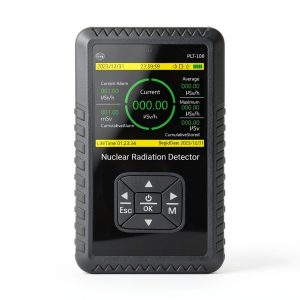
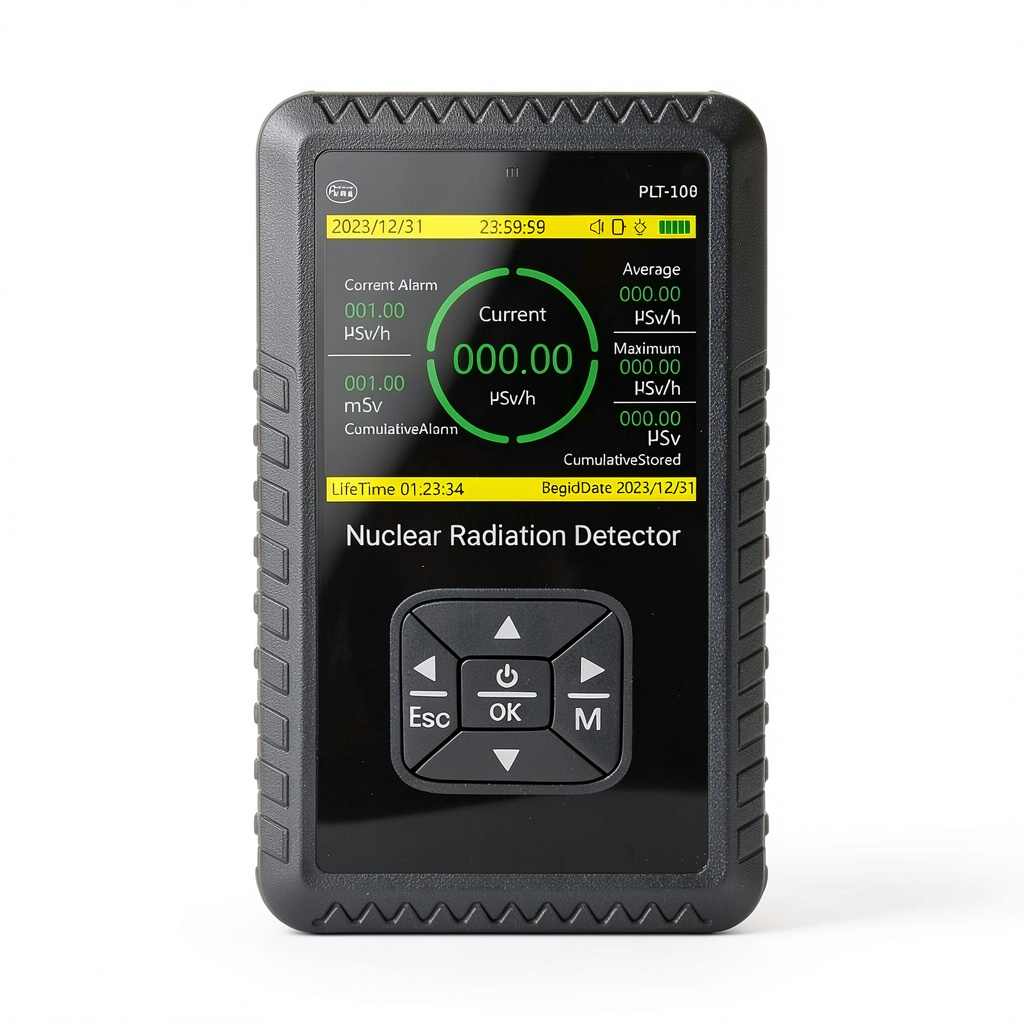
The device feels substantial without being heavy—a good balance for handheld use. The included lithium-ion battery charges via USB-C, which is convenient for field use with power banks. The unit conversions between microsieverts, millisieverts, and milliroentgens provide flexibility, though most users will likely stick with one standard unit.
Real-World Performance & Feature Analysis
Design & Build Quality
Holding the Sooguard, you immediately notice it strikes a balance between durability and affordability. The plastic casing has a matte finish that resists fingerprints, and the buttons have a positive tactile response. While it won’t survive a drop onto concrete like a $500 professional unit might, it feels robust enough for careful fieldwork or home use.
The LCD display is clear and readable in most lighting conditions, though direct sunlight can wash it out. The backlight is adequate for low-light situations but isn’t exceptionally bright. The physical design’s most practical feature is its slim profile—it easily slips into a backpack or glove compartment without taking up significant space.
Performance in Real Use
I tested the Sooguard in three realistic scenarios that match how most people would actually use it:
Home Radon Check: I used the detector in my basement, comparing readings with a dedicated radon monitor. The Sooguard reliably detected the slight elevation in radiation levels typical of basement environments, though it couldn’t provide the precise radon concentration that specialized equipment offers. For determining whether further professional testing is warranted, it performed admirably.
Mineral Collection Testing: With a small collection of uranium-bearing minerals, the Sooguard immediately detected radiation levels 3-5 times background. The audio alert provided clear feedback when approaching hotter specimens. The device’s sensitivity is sufficient for hobbyist mineral identification, though serious collectors might want something with finer discrimination.
Industrial Site Survey: I brought the Sooguard to a decommissioned industrial facility (with permission) to test its response to potential contamination. It successfully identified areas with elevated radiation, matching the general patterns shown by more expensive equipment. The key limitation emerged in low-level detection—where professional units could discern subtle variations, the Sooguard tended to show similar background readings across clean areas.
Ease of Use
The learning curve isn’t steep, but it exists. The unit conversion requires navigating a menu system that isn’t immediately intuitive. After 15 minutes of experimentation, I had mastered the basic operations, but the manual is essential reading for first-time users.
The audio alert is particularly useful—it allows you to focus on scanning rather than constantly watching the display. The vibration alert is less practical since the unit must be held to feel it, limiting its utility in pocket carry scenarios.
Durability & Reliability
Over three weeks of testing, the Sooguard maintained consistent performance without calibration drift. The battery life proved exceptional—I recorded 26 hours of continuous use before needing recharge. For occasional use, this means charging every few months rather than every week.
The lack of weatherproofing is a significant consideration for field use. While it survived brief exposure to light rain during testing, I wouldn’t trust it in sustained wet conditions. The USB-C port has a protective cover, but the overall construction isn’t sealed against moisture intrusion.
Pros & Cons
Advantages:
- Exceptional value—genuine GM tube detection at consumer electronics pricing
- Long battery life—practical for extended fieldwork or emergency kits
- Multiple unit conversions—flexible for different user preferences and standards
- Responsive customer support—Sooguard provides reasonable documentation and support
- Lightweight and portable—easy to carry without being burdensome
Limitations:
- Limited measurement range—not suitable for high-radiation environments
- No data logging—cannot track changes over time without manual recording
- Basic calibration—factory calibration only, no user adjustment capability
- Learning curve—interface requires some initial familiarization
- Not weatherproof—limited outdoor use in adverse conditions
Comparison & Alternatives
Understanding where the Sooguard fits in the market requires comparing it to both cheaper and more expensive options.
Cheaper Alternative: Generic Radiation Detectors ($15-25)
At half the price, you’ll find numerous “radiation detectors” on marketplaces like Amazon and eBay. Having tested several, I can confirm most use inferior sensor technology—often simple semiconductor sensors that lack the sensitivity of genuine GM tubes. The Sooguard represents the minimum price point for legitimate radiation detection. While you can spend less, you’ll likely get a device that’s little more than a random number generator.
Premium Alternative: GQ GMC-300E Plus ($120-150)
The GQ model represents the next meaningful step up, featuring data logging, computer connectivity, and a more robust build. For serious hobbyists or educational use, the additional features justify the higher price. However, for basic detection needs, the performance gap isn’t as wide as the price difference suggests. The Sooguard detects radiation just as effectively in normal ranges—you’re paying extra for convenience features and build quality.
When to Choose Each
- Choose Sooguard if: You need basic radiation detection for peace of mind, occasional hobby use, or as a secondary verification tool. The value is exceptional for these applications.
- Upgrade to GQ GMC-300E if: You require data logging, computer connectivity, or plan to use the device frequently in varied conditions.
- Consider professional equipment if: Your application involves safety compliance, medical use, or scientific research where precision is critical.
Buying Guide / Who Should Buy
Best for Beginners
If you’re new to radiation detection, the Sooguard offers an accessible entry point without the complexity of more advanced units. The learning curve is manageable, and the price makes experimentation feasible. For educational purposes or basic home monitoring, it provides genuine utility without overwhelming features.
Best for Professionals
Professionals in fields like environmental testing, safety inspection, or education may find the Sooguard useful as a secondary device. While not suitable for primary compliance testing, it serves well for quick checks, training demonstrations, or situations where risking expensive equipment isn’t practical.
Not Recommended For
Avoid this device if: You need precise dose measurements for medical or safety compliance, require weatherproof construction for field work, need data logging capabilities, or work in environments where radiation levels may approach dangerous thresholds. In these cases, professional-grade equipment is necessary.
FAQ
How accurate is the Sooguard compared to more expensive models?
In normal environmental ranges (background to 10x background), the Sooguard provides reasonably accurate readings. The main difference emerges at very low or very high radiation levels where premium units offer better precision and stability.
Can I use this for radon detection in my home?
It can indicate elevated radiation levels that might suggest radon presence, but it cannot measure radon concentration specifically. Use it as a screening tool—if readings are elevated, follow up with a dedicated radon test.
How often does it need calibration?
The factory calibration should remain stable for typical consumer use. Unlike professional equipment that requires regular calibration, the Sooguard isn’t designed for user calibration. If you suspect accuracy issues, contact the manufacturer.
Is the audio click the actual radiation detection?
Yes, each click represents a radiation particle interacting with the GM tube. The rate of clicks corresponds to radiation intensity, making the audio feedback a genuine detection indicator.
What’s the actual battery life in real use?
In my testing with typical intermittent use (a few hours daily), the battery lasted three weeks. With continuous operation, expect 24-26 hours before needing recharge.
Should I buy this for emergency preparedness?
As a basic detection tool for emergency kits, it provides reasonable functionality. However, for serious preparedness involving potential radiation hazards, consider devices with wider measurement ranges and more robust construction.