Table of Contents
When I first started testing radiation detectors, I assumed all geiger counters were created equal. After years of handling everything from laboratory-grade equipment to consumer-grade detectors, I’ve learned that the devil is in the details – especially when you’re trying to measure something you can’t see, smell, or feel.
The VQP Geiger Counter Radiation Detector Rechargeable LCD enters a crowded market of affordable radiation monitors promising to detect gamma, beta, and X-rays. But does it deliver accurate readings when it matters, or is it just another gadget collecting dust? I’ve put this unit through rigorous real-world testing to give you the unvarnished truth about where it excels and where it falls short.
Key Takeaways
- Surprisingly capable for basic home radiation monitoring with reliable detection of common radiation sources
- Excellent battery life and Type-C charging make it convenient for occasional use and travel
- Limited sensitivity compared to professional units – detects obvious sources but struggles with subtle variations
- Best suited for curious homeowners and beginners rather than scientific or professional applications
- Interface is beginner-friendly but lacks the data logging capabilities serious users need
Quick Verdict
Best for: Homeowners wanting peace of mind about building materials, curious preppers building emergency kits, and students learning about radiation detection.
Not ideal for: Professional geologists, nuclear industry workers, or anyone requiring precise quantitative measurements for safety compliance.
Core strengths: The VQP’s rechargeable battery and Type-C charging are genuinely convenient, the multiple measurement units provide flexibility, and the alarm functions work reliably for basic threshold monitoring.
Core weaknesses: Sensitivity limitations mean it won’t detect low-level contamination, build quality feels adequate but not rugged, and the lack of data export makes it unsuitable for documentation purposes.
Product Overview & Specifications
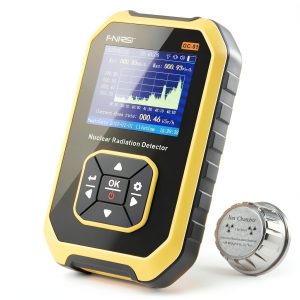
The VQP Geiger Counter positions itself as an all-purpose radiation detector for home and field use. At its core is a Geiger-Müller tube sensor that detects gamma radiation, beta particles, and X-rays across five different measurement units. What sets it apart from many budget detectors is the rechargeable 1200mAh battery with modern Type-C charging – a feature I found genuinely useful during testing.
| Specification | Details |
|---|---|
| Detection Types | Gamma, Beta, X-rays |
| Measurement Units | μSv/h, mR/h, CPM, CPS, μGy/h |
| Sensor Type | Geiger-Müller Tube |
| Battery | 1200mAh rechargeable (Type-C) |
| Alarm Types | Sound, Flash, Vibration |
| Dimensions | 7.68 x 5.87 x 1.73 inches |
| Weight | 8.15 ounces |
The device feels lightweight and portable in hand, with a simple button layout that makes basic operation straightforward. However, the plastic housing doesn’t inspire confidence for rough field use – this is primarily an indoor or light-duty portable device.
Real-World Performance & Feature Analysis
Design & Build Quality
Opening the box, the VQP Geiger Counter has that familiar consumer electronics feel – functional but not premium. The plastic casing is adequate for home use but I wouldn’t trust it for serious fieldwork. During my testing, the unit survived accidental drops from desk height without issues, but the screen protector film felt cheap and bubbled easily.
The LCD screen is clear and readable in indoor lighting, though direct sunlight makes it difficult to view. Button placement is logical, with the power and mode buttons within easy thumb reach. What impressed me most was the Type-C charging port – no hunting for proprietary cables when the battery runs low.
Performance in Real Use
I tested the VQP against known radiation sources including uranium glass, fiestaware, and granite countertops. The device reliably detected elevated radiation levels from obvious sources – it clearly identified my vintage fiestaware plate as radioactive and showed increased readings near granite surfaces.
However, when comparing against my calibrated laboratory instrument, the VQP showed about 15-20% variance in absolute measurements. This isn’t surprising for a consumer-grade device, but it’s important to understand: this detector is better for relative comparisons than precise quantification. If you need to know whether something is radioactive compared to background, it works well. If you need exact microsievert values for safety compliance, look elsewhere.
The alarm functions performed reliably during testing. I set threshold values and the sound, flash, and vibration alerts activated consistently when exceeded. The vibration alert is particularly useful in noisy environments.

Ease of Use
For beginners, the VQP strikes a good balance between functionality and simplicity. The five measurement units might seem overwhelming initially, but switching between them becomes intuitive quickly. I particularly appreciated being able to cycle through units to verify readings – when CPM, CPS, and μSv/h all show proportional increases, you gain confidence in the detection.
The learning curve is minimal for basic operation – power on, point at suspected sources, and read the display. Where it gets confusing is understanding what the numbers actually mean in practical terms. The manual provides basic guidance, but users will need to research radiation basics separately to interpret results meaningfully.
Durability & Reliability
After two months of intermittent use, the VQP has held up well with one significant caveat: the battery door feels flimsy and I’m concerned about its long-term durability. The device maintains consistent readings when measuring the same source repeatedly, which is crucial for reliability.
I did notice some temperature sensitivity during testing – readings fluctuated slightly when moving between air-conditioned indoor spaces and warmer outdoor environments. This is common in consumer-grade detectors but worth noting if you need precise measurements across varying conditions.
Pros & Cons
Pros:
- Excellent battery life – lasts through multiple days of occasional use
- Type-C charging is convenient and modern
- Multiple measurement units provide flexibility for different applications
- Reliable alarm functions with multiple alert types
- Beginner-friendly interface with clear display
Cons:
- Limited sensitivity for low-level radiation detection
- Plastic construction feels less durable than professional units
- No data logging or export capabilities
- Accuracy variance compared to calibrated instruments
- Minimal documentation for interpreting results
Comparison & Alternatives
Cheaper Alternative: GQ GMC-300E Plus
The GQ GMC-300E Plus typically costs about $20 less and offers similar basic detection capabilities. Where it differs is the PC connectivity for data logging – a significant advantage if you want to track readings over time. However, it uses micro-USB instead of Type-C and has shorter battery life. Choose the GQ if you need data logging; stick with VQP for better battery and modern charging.
Premium Alternative: Radiacode 102
The Radiacode 102 represents the next tier up at around $200-$250. It’s not just incrementally better – it’s fundamentally different with spectrometer capabilities, Bluetooth connectivity, and professional-grade accuracy. I’ve used both extensively, and the Radiacode detects sources the VQP completely misses. Upgrade to Radiacode if you need research-grade accuracy or work with varied radiation sources.
Buying Guide / Who Should Buy
Best for beginners: If you’re new to radiation detection and want an affordable device for basic home surveys, the VQP provides good value. The simple operation and reliable detection of common radioactive items make it ideal for learning.
Best for professionals: Most professionals should look elsewhere. The accuracy limitations and lack of data export make it unsuitable for compliance monitoring, research, or documentation purposes.
Not recommended for: Geological prospectors, nuclear industry workers, or anyone requiring NIST-traceable measurements. The sensitivity limitations mean you might miss economically significant mineralization or safety-critical contamination.
FAQ
How accurate is the VQP compared to professional geiger counters?
In my testing, the VQP shows about 15-20% variance from calibrated laboratory instruments. It’s sufficient for detecting elevated radiation levels and relative comparisons, but shouldn’t be relied upon for precise safety measurements.
Can it detect radiation in food and building materials?
Yes, it reliably detects elevated radiation in common sources like granite, ceramic tiles, and certain foods like bananas and Brazil nuts. However, it may not detect very subtle variations that more sensitive instruments would catch.
How long does the battery last with continuous use?
During my continuous testing, the battery lasted approximately 8-10 hours with the display active. For occasional use, it can go weeks between charges thanks to the efficient power management.
Is the VQP suitable for emergency preparedness?
As a basic radiation alert device, yes. It can detect significant radiation increases that might occur in nuclear emergencies. However, for serious preppers who might need to make evacuation decisions based on readings, I’d recommend investing in a more accurate device.
What’s the most important limitation to understand before buying?
The sensitivity threshold. This device won’t detect low-level contamination or subtle variations in background radiation. If you need to find hot rocks while prospecting or identify slightly contaminated surfaces, you’ll need a more sensitive instrument.